
Descripción
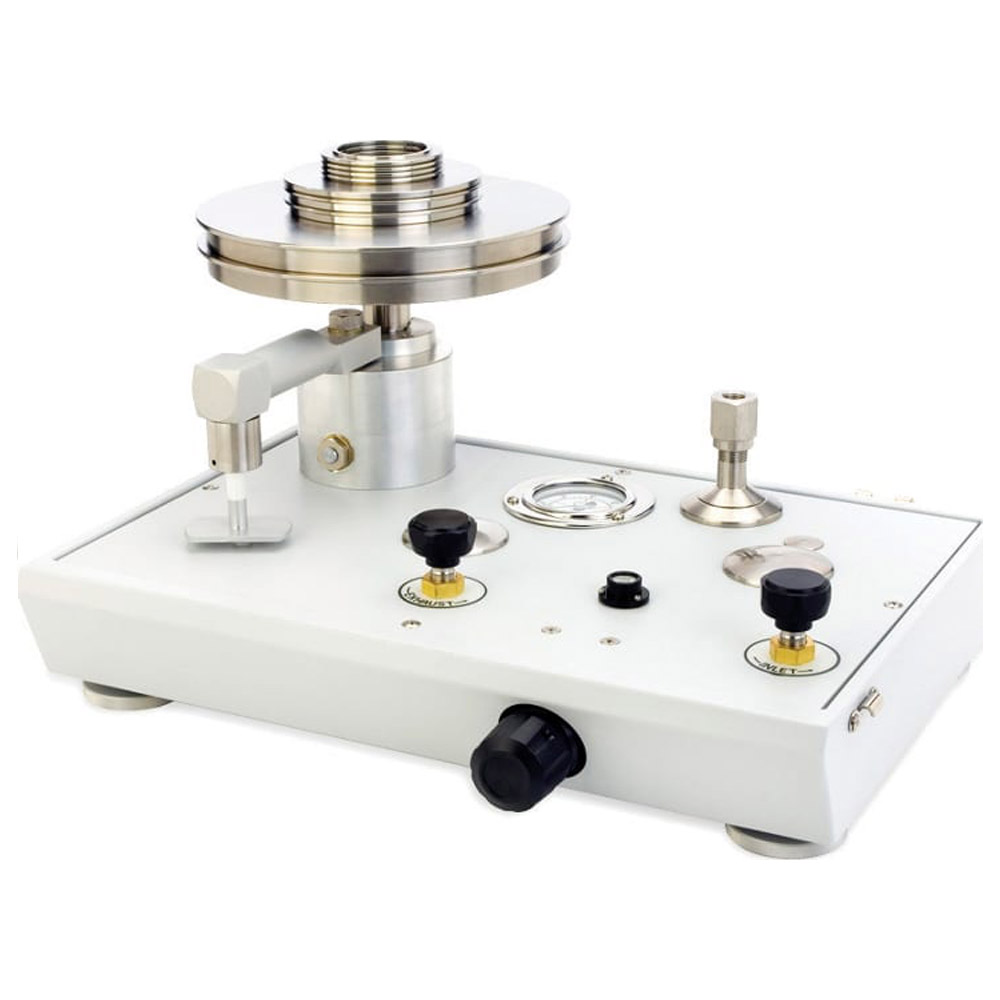
Fluke P3000 Series Pneumatic Deadweight Testers

Air Operated – Single PCU
- Pressure Range 400 inH20
- Accuracy better than 0.015 % of reading. (Increased accuracy option of 0.008 %)
- Gas operated with optional hand pumps
The Fluke P3000 Series is the culmination of over 50 years’ experience in the production and design of primary pressure standards. With features designed to improve accuracy and performance, increase reliability and simplify operation these deadweight testers can be used to calibrate virtually any pressure sensing device, including transducers, transmitters, gauges or pressure switches.
Each instrument is supplied with a detachable lid that makes it neat, compact and easily portable. The masses are stored in a high-quality case with a self-locking mechanism to protect them during transit.
All units are provided with an accredited calibration certificate, M14X1.5, M20X1.5, 1/8, 1/4, 3/8, and 1/2 NPT and BSP female adaptors, operating fluid (where applicable) and spare seals.
The piston/cylinder assemblies are manufactured to the very highest standards and are supplied with accredited calibration reports with stated instrumental measurement uncertainties.
Operating principle
Deadweight testers are the primary standard for pressure measurements. Utilizing the well proven piston-gauge system consisting of a vertically mounted, precision lapped piston and cylinder assembly, accurately calibrated masses (Force) are loaded on the piston (Area), which rises freely within its cylinder. These masses balance the upward force created by the pressure within the system.

Instrument base
There are four basic variations in the pneumatic offering; single pressure, single vacuum, dual vacuum and pressure, and oil-lubricated pneumatically driven high-pressure models. Pressure or vacuum is generated by an external source or an optional built-in hand pump (standard on the lower pressure models). The hand pump option is not available on instruments above 500 psi (3.5 MPa).
Piston/cylinder assemblies
The piston/cylinder assembly is the heart of each deadweight tester. They are manufactured from materials that provide stability, durability, and low thermal coefficients and distortion. Our experience and knowledge of piston/cylinder production and calibration ensure the precision and performance required for today’s demanding calibration requirements.
Masses
Standard masses are series 3 non-magnetic austenitic stainless steel. Each mass is marked with the serial number of the instrument and the nominal pressure value relative to the high- or low-pressure piston, when applicable. The masses for the vacuum ranges and the optional fine increment masses are stainless steel and/or aluminum.
Gravity correction
Gravity varies significantly with geographical location and this variation has a direct effect on the force of the weights and the accuracy of the deadweight tester. Each instrument can be calibrated to local gravity at no extra cost. If unspecified, instruments will be calibrated to Standard Gravity at 980.665 cm/s2.
Gas supply
All instruments are fitted with a 1/4 inch NPT female external supply port for connection to the gas supply source. A compressed gas bottle (nitrogen or dry air) fitted with a pressure regulator is recommended. Ten percent above the maximum pressure is required. A built-in hand pump is available on some models to generate pressures to 300 psi (2 MPa).
For vacuum requirements, an external vacuum pump can be connected to the 1/4 inch port. The built-in hand pump will also generate up to 90 % vacuum.
PressCal Software
Windows-based software program that allows users to easily apply all necessary corrections to enhance the deadweight tester performance. Calibration details are then stored and/or used to automatically create a calibration certificate. The use of PressCal allows for an improved accuracy of 0.008%.
P3000 Series Vacuum and Dual Vacuum/Pressure Models
The combined vacuum/pressure models are extremely versatile instruments providing vacuum through 500 psi (3.5 MPa) capacity in one unit. An optional built-in hand pump can be installed to generate vacuum (90 %) through 300 psi (2 MPa).

P3000 Series Liquid Lubricated Gas Operated Models
The Models P3031 and P3032 feature an oil lubricated piston/cylinder assembly, which ensures that the instrument is less susceptible to performance issues caused by contamination of the gas supply or the environment in which the unit is being operated.
The supply gas, via the deadweight tester controls, is introduced into the piston/cylinder chamber. As the gas acts directly on the surface of the oil, there is a rate-less transfer of pressure within the system.

The instrument is designed to prevent inadvertent over-filling of the chamber, thus avoiding contamination of the gas system. There is no physical barrier between the gas and oil so there is some «oil-mist» transfer potential. Therefore, we do not recommend the standard version for oxygen service. A special version of these instruments using a hydrocarbon free fluid is available.
Cross-sectional illustration of liquid lubricated piston chamber

Manufacturer Specs
| Specifications | ||
| Accuracy | ±0.015% of reading (±0.008% optional) | |
| *Accuracy based on % of reading from 10% to 100% of the piston range when used in accordance with the corrections found on the calibration certificate. Below 10% ± (accuracy class) x 10% of the piston range. | ||
| Mass and PCU Materials of Construction | ||
| Standard weight material | Series 3 non-magnetic austenitic stainless steel | |
| Weight density | 2.7 g/cm³ | |
| Optional fractional weights | Solution heat treated aluminum | |
| Models P3011, P3012, P3013, P3022, P3023, P3025 (V) | Piston Material: Cylinder Material: Coefficient of Expansion: |
Ceramic Martensitic steel 11 ppm/°C |
| Models P3014, P3015, P3025 (P) P3031, P3032 (P & V) | Piston Material: Cylinder Material: Coefficient of Expansion: |
Tungsten carbide Martensitic steel 16.5 ppm/°C |
| Model P3016 | Piston Material: Cylinder Material: Coefficient of Expansion: |
Tungsten carbide Tungsten carbide 11 ppm/°C |
| General | ||
| Test port adaptors | 1/8, 1/4, 3/8 and ½ NPT or BSP | |
| Instrument weight | 24 lbs | |
| Instrument size | 17.5 W x 12 D x 8.5 H | |
| Mass set weight (typical) | 65 lbs | |
| Minimum Standard Weight Increments | ||
| P3012, P3022 Pressure | 1 inH2O, (5 mbar) | |
| P3013, P3023 Pressure | 2 inH2O, (10 mbar) | |
| P3014, P3015, P3025 Pressure | 1 psi, (0.1bar) | |
| P3016, P3031, P3032 Pressure | 1 psi, (0.1bar) | |
| P3011, P3022, P3023, P3025 Vacuum | 0.2 inHg (10 mbar) | |
| Optional Fractional Weights | ||
| P3014, P3015, P3025 Pressure | 0.1 psi (0.01 bar) | |
| Built-in Hand Pumps | ||
| Pressure mode | Max pressure 300 psi (20 bar) | |
| Vacuum mode | To 90% vacuum | |
| Operating Fluid for Liquid Lubricated Models | ||
| 55-655 | mineral oil (standard) | |
| Krytox | for oxygen-safe applications (optional) | |
| Options | ||
| PressCal Software | Windows-based software program that allows users to easily apply all necessary corrections to enhance the deadweight tester performance. Calibration details are then stored and/or used to automatically create a calibration certificate. PressCal is provided as standard with all 0.008% instruments. | |
| Krytox | As operating fluid for liquid lubricated gas operated models. | |
Tech Specs
Test Equipment General Attributes |
|
|---|---|
| ECCN Number | EAR99 |
| Country of Origin | United States |


Valoraciones
No hay valoraciones aún.