
Descripción
Digilent MCC 134 – 24-Bit, 4-Channel Thermocouple Measurement DAQ HAT for Raspberry Pi
- Four isolated thermocouple inputs
- 24-bit A/D converter
- Thermocouple types J, K, R, S, T, N, E, and B supported
- 1 second update interval, minimum
- Cold junction compensation
- Screw terminal connections
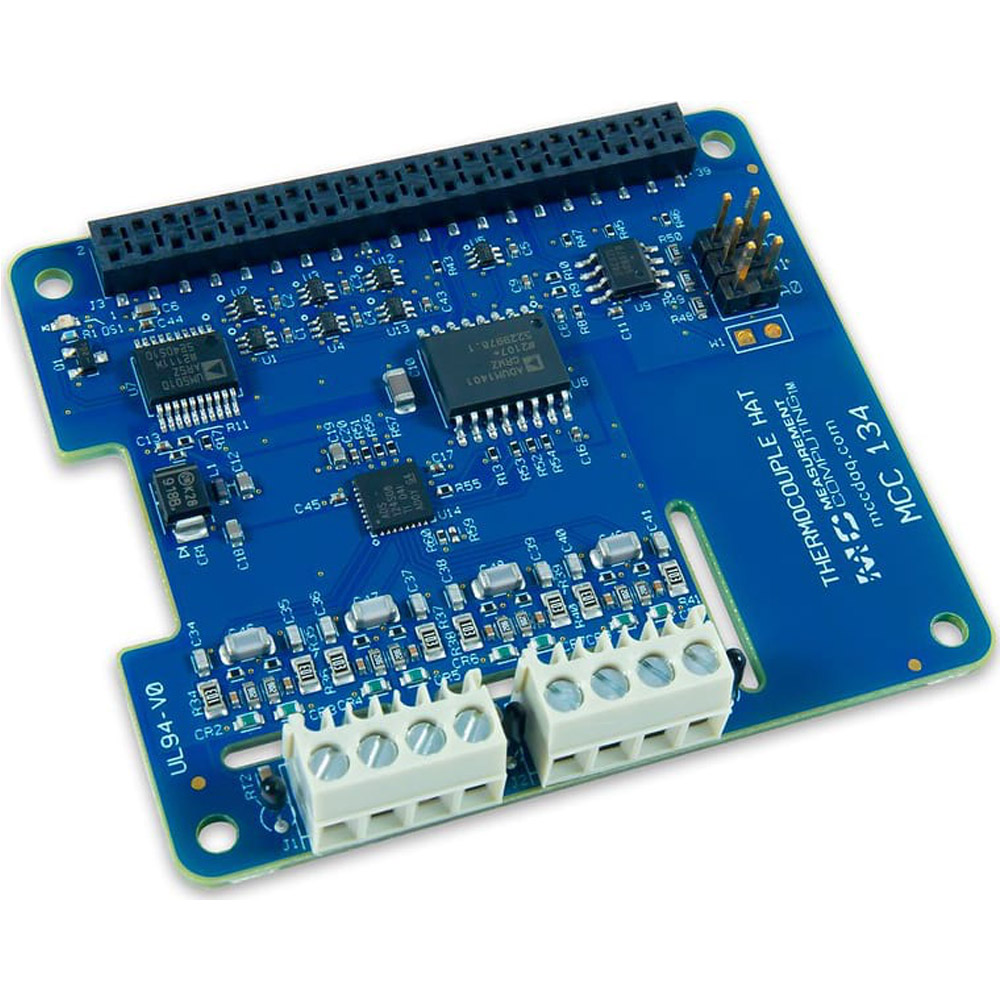
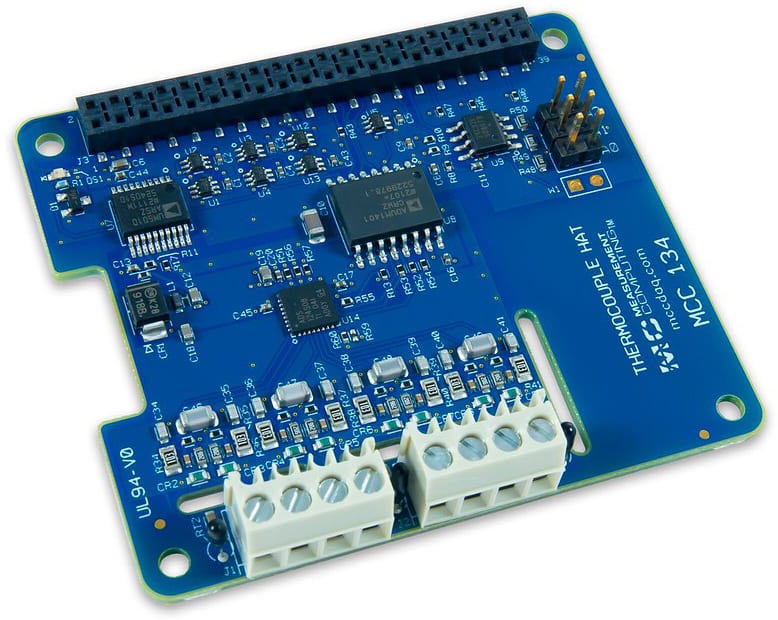
The Measurement Computing MCC 134 is a thermocouple measurement HAT (Hardware Attached on Top) designed for use with Raspberry Pi®. It features 24-bit resolution and provides professional-grade accuracy which is best in class. The MCC 134 provides four isolated thermocouple inputs. Users can connect up to four differential thermocouples (TC) to the MCC 134 input channels. TC types are software-selectable per channel. TC values can be updated every 1 second, minimum. The MCC 134 is equipped with open thermocouple detection (OTD) for all TC input channels so users can monitor the board for broken or disconnected thermocouples. It also has three high-resolution cold-junction compensation (CJC) sensors.
HAT configuration parameters are stored in an onboard EEPROM that allows the Raspberry Pi to automatically set up the GPIO pins when the HAT is connected. The open-source MCC DAQ HAT Library of commands in C/C++ and Python allows users to develop applications on the Raspberry Pi using Linux. The MCC DAQ HAT Library supports operation with multiple MCC DAQ HATs running concurrently. Console-based and user interface (UI) example programs are available for each API.
Board components
Screw Terminals
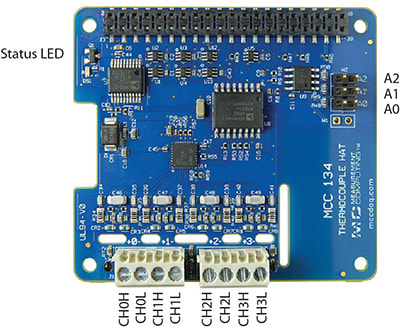
- CH0H/CH0L to CH3H/CH3L (+x-): Differential thermocouple input terminals.
Address Jumpers
- A0 to A2: Used to identify each HAT when multiple boards are connected. The first HAT connected to the Raspberry Pi must be at address 0 (no jumper). Install jumpers on each additional connected board to set the desired address.
Status LED
The LED turns on when the board is connected to a Raspberry Pi with external power applied.
Header Connector
The board header is used to connect with the Raspberry Pi.
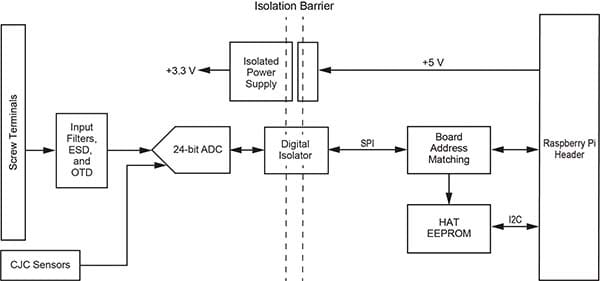
Functional Block Diagram
Functional Details
Best practices for accurate thermocouple measurements
The MCC 134 should achieve results within the maximum thermocouple accuracy specifications when operating within the documented environmental conditions. Operating in conditions with excessive temperature transients or airflow may affect results. In most cases, the MCC 134 will achieve the typical specifications. To achieve the most accurate thermocouple readings, MCC recommends the following practices:
- Reduce the load on the Raspberry Pi processor. Running a program that fully loads all 4 cores on the Raspberry Pi processor can raise the temperature of the processor above 70 °C. Running a program that only loads 1 core will operate approximately 20 °C cooler.
- Minimize environmental temperature variations. Place the MCC 134 away from heat or cooling sources that cycle on and off. Sudden environmental changes may lead to increased errors.
- Provide a steady airflow, such as from a fan. A steady airflow can dissipate heat and reduce errors.
- When configuring multiple MCC DAQ Hats in a stack, position the MCC 134 farthest from the Raspberry Pi board. Since the Raspberry Pi is a significant heat source, placing the MCC 134 farthest from the Pi will increase accuracy.
Tech Specs
Dataloggers / Data Acquisition/Dataloggers for Environmental Variables/Temperature Dataloggers Templ |
|
|---|---|
| # Inputs/Channels | 4 |
| LCD Screen | No |
| Software Included | Yes |
Test Equipment General Attributes |
|
| Product Height | 0.47 IN |
| Product Length | 2.56 IN |
| Product Width | 2.22 IN |
| Shipping Weight | 1.00 LBS |
| Data Logging | Yes |
| HTS/Schedule B Number | 8473301180 |
| ECCN Number | EAR99 |
| Country of Origin | Hungary |
| Shipping Height | 3.00 IN |
| Shipping Length | 1.00 IN |
| Shipping Width | 3.00 IN |


Valoraciones
No hay valoraciones aún.