

Descripción
Fluke T6-TPAK-HT6-AC – T6-1000 Tester

- Test leads not required
- Simultaneous voltage and current display
- 1 to 1000V AC or DC
The Fluke T6-1000 is the first-ever instrument of its kind. Thanks to Fluke’s unique FieldSense technology, the T6 is capable of measuring voltage up to 1000V AC using only the meter’s open fork. This means you don’t need to open any covers or remove wire nuts to take voltage readings on AC sources. The meter’s open fork jaw measures 17.8mm and is large enough to fit wires up to AWG 4/0. Plus, the T6-1000 can also measure current up to 200A AC through its open fork while simultaneously showing voltage and current readings on its backlit screen.
Important Specs
Thanks to FieldSense, you can use the T6-1000 to measure multiple electrical parameters through the meter’s open jaw alone. FieldSense supports the measurement of AC voltage up to 1000V, AC current up to 200A, and frequency from 45Hz – 66Hz (FieldSense frequency is only available on the T6-1000 model). You can measure all these parameters without test leads using only the meter’s open jaw. That said, the T6-1000 does come with built-in test leads which allow you to measure AC and DC voltage up to 1000V, and resistance in multiple ranges including 2000Ω, 20.00kΩ, and 100.0 kΩ.
It is important to note that in order to get the most from FieldSense Technology, the T6 meter must have a capacitive path to ground. In most applications, this is provided by the user via a ground contact on the rear of the meter. However, in some cases, a ground connection must be made using one of the built-in test leads. FieldSense can only measure voltage relative to the ground and must have a solid ground connection. Phase to phase measurement is not possible with FieldSense.
Measure Voltage Without Test Leads
Contacting electrical conductors with test leads or alligator clips requires metal-to-metal contact, which as any electrician or technician knows, carries the potential for arc flash. FieldSense eliminates that step. The person performing the test is safer from potential electrical shock because the measurement tool and the voltage source under test are isolated. This is performed by means of galvanic isolation or separation, the principle that isolates functions of an electrical current to prevent current flow.

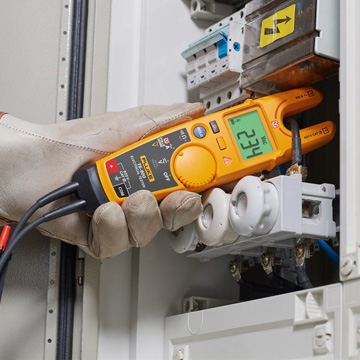
Stay Safe, Save Time
Unlike current sensing technologies which detect a magnetic field to derive current measurements, FieldSense technology actually detects an electrical field. This new method involves transducing and calculating a known signal to derive measurements for the source voltage. The meter itself generates a reference signal of known amplitude and frequency. When grounded, the resulting composite waveform is detected by an electronic sensor built into the tester. After amplification, processing and digital calculations, voltage and frequency measurements are derived.
How to Measure AC Voltage & Current with FieldSense (4 Simple Steps)
Once you have your T6 in hand, ditching your test leads and taking measurements with FieldSense is relatively simple. The most important thing for getting accurate readings with FieldSense is making sure you have a solid ground connection.
- Turn the meter’s dial knob to the second position, or «FieldSense» function. The tester measures and simultaneously displays both AC voltage and AC amps on the T6-1000.
- Make sure you create a solid ground connection for the meter. In most cases you can do this with your finger touching the ground contact on the back of the meter. However, if you are using insulated gloves, standing on an insulated ladder or otherwise insulated from ground, you must place the meter’s black test lead on a ground conductor or attach it to ground with an alligator clip.
- Once you are grounded, slide the meter’s open jaw over the conductor under test to see voltage and current levels.
- You will then see your reading on-screen – make sure to note the units of measurement. You can also press the HOLD button to momentarily freeze the reading for a quick snapshot of the screen readout.

Regardless of the T6’s improvements to safety in taking electrical measurements, workers should still wear appropriate personal protective equipment (PPE). This means electricians should still wear arc-rated clothing and protective equipment including gloves, safety glasses or goggles, hearing protection and leather footwear. In lower voltage areas, measurements can be taken wearing minimal PPE, including gloves and protective eyewear. However, measuring without test leads does not mean you can skip wearing the required PPE.
Manufacturer Specs
| General Specifications | |
| Calibration | 1-year calibration cycle |
| Dimensions | 61.1 mm x 259.3 mm x 43.8 mm |
| Fork opening | 17. 8 m m |
| Temperature | |
| Operating: | -10 °C to +50 °C (14 °F to 122 °F) |
| Storage: | -30 °C to +60 °C (-22 °F to +140 °F) |
| Altitude | |
| Operating: | 2,000 m (6,562 feet) |
| Storage: | 10,000 m (32,808 feet) |
| Relative Humidity | 0 % to 90 %, 5 °C to 30 °C (41 °F to 86 °F) 0 % to 75 %, 30°C to 40 °C (86 °F to 104 °F) 0 % to 45 %, 40°C to 50 °C (104 °F to 122 °F) |
| Battery Type and Life | 2 x AA (IEC LR6); 360 hours continuous, typical; 200 hours using FieldSense |
| RF Field Specification | 0.5 % full scale + (specified accuracy) at 3 V / m |
| Enclosure Rating | IP 52 per IEC/EN 60529, no vacuum applied |
| Temperature coefficient | 0.1 x (specified accuracy) / °C for <18°C or >28 °C (< 64.4 °F or > 82.4 °F) |
| Safety | IEC/EN 61010-1, IEC/EN 61010-2-033: Pollution Degree 2 |
| Electromagnetic Environment | IEC/EN 61326-1: Portable |
Tech Specs
Test Equipment General Attributes |
|
|---|---|
| Product Height | 3.00 IN |
| Product Length | 13.00 IN |
| Product Width | 7.00 IN |
| HTS/Schedule B Number | 9030.31.0000 |
| ECCN Number | 3A992 |
| Country of Origin | United States |
| Shipping Height | 3.00 IN |
| Shipping Length | 13.00 IN |
| Shipping Width | 7.00 IN |


Valoraciones
No hay valoraciones aún.